
A dear friend of mine gifted me with this book (in preparation of law school), saying that she had to read it in her pre-law course:
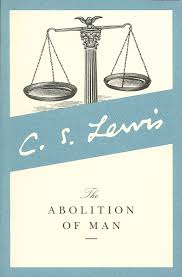
I have always been a fan of Clive… As a wide-eyed child, “The Lion, the Witch, and the Wardrobe” introduced me to a fantasyland and always made me peer into closets with secret hope & wonder. “Mere Christianity” and especially “Surprised by Joy” helped build the foundation for my faith as I related to his own spiritual journey. I became more vigilant to the insidious, sneaky ways of the enemy through “The Screwtape Letters.” “A Grief Observed” offered me a sense of empathy and taught me it was okay to go through cycles of grief and mourning for loved ones. All these books came at the right stage of my life, and this book was no exception, considering I was talking about moral relativism just two posts ago!
This book, like his other books, was short in length, but extremely dense in content. I feel like I have to reread it in order to understand the depth and breadth of his argument. In this one, C.S Lewis addresses and criticizes those in academia who wholly reject this idea of universal truth and those who put a sharp divide between reason and sentiment.
“It is the doctrine of objective value, the believe that certain attitudes are really true, and others really false, to the kind of thing the universe is and the kind of things we are. Those who know [this] can hold that to call children delightful or old men venerable is not simply to record a psychological fact about our own parental or filial emotions at the moment, but to recognize a quality which demands a certain response from us whether we make it or not…. No emotion is, in itself, a judgment; in that sense all emotions and sentiments are alogical. But they can be reasonable or unreasonable as they conform to Reason or fail to conform. The heart never takes the place of the head: but it can, and should, obey it.”
“The head rules the belly through the chest – of emotions organized by trained habit into stable sentiments. The chest-magnanimity-sentiment -> these are the indispensable liaison officers between the cerebral man and the visceral man. It may even be said that it is by this middle element that man is man; for by his intellect he is mere spirit and by his appetite mere animal… it is not excess of thought but defect of fertile and generous emotion that marks [these academic men] out. Their heads are no bigger than the ordinary; it is the atrophy of the chest beneath that makes them seem so.”
 small soggy fry